The Strait of Hormuz — Why This Tiny Waterway Controls What You Pay for Petrol in Chennai
Last week I stopped to fill petrol on my way to work in Chennai. Rs 102 per litre. I stood there at the pump doing the mental arithmetic of how much of my monthly salary goes purely into fuel costs — the commute, the occasional long drive, the small daily errands that add up. It is a significant number. And as someone who works in IT and therefore spends more time than most people thinking about why systems work the way they do, I found myself genuinely curious about the actual reason petrol costs what it costs in India.
The answer, I discovered, runs through a stretch of water about 33 kilometres wide at its narrowest point, sitting between Iran and Oman at the mouth of the Persian Gulf. It is called the Strait of Hormuz. I had heard the name before — it appears in news headlines periodically — but I had never actually understood what it was or why it kept appearing in articles about oil prices. Once I understood it properly, the Rs 102 on that petrol pump made complete sense in a way it never had before.
What the Strait of Hormuz Actually Is
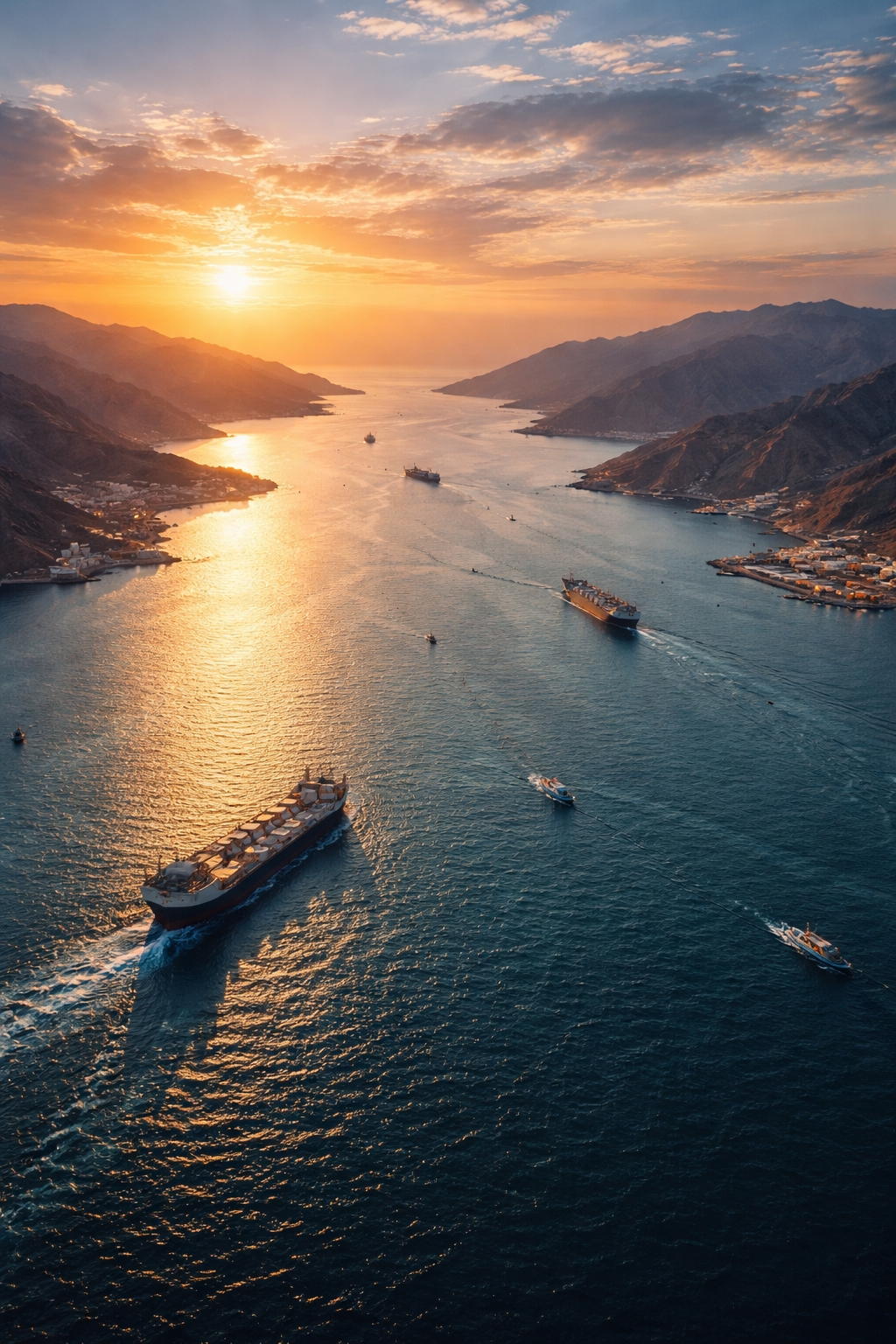
The Strait of Hormuz is a narrow channel of water connecting the Persian Gulf to the Gulf of Oman and then to the Arabian Sea. On one side is Iran. On the other side is Oman and the United Arab Emirates. The strait is the only maritime exit from the Persian Gulf — which means that every ship carrying oil out of Saudi Arabia, Iraq, Kuwait, the UAE, and Qatar must pass through this single narrow channel to reach the rest of the world.
Here is the number that made me stop and re-read it twice when I first encountered it. Approximately 21 million barrels of oil pass through the Strait of Hormuz every single day. That is roughly 20 percent of all the oil traded globally — one fifth of the entire world's daily oil supply flowing through a channel that, at its narrowest point, is barely wider than the distance from Chennai Central to Marina Beach.
Why This Directly Affects Your Petrol Bill in Chennai
India imports approximately 85 percent of the oil it consumes. We do not produce enough domestically to meet our needs. Of that imported oil, a very significant portion comes from countries in the Persian Gulf region — Saudi Arabia, Iraq, UAE — which means it passes through the Strait of Hormuz on its way to Indian refineries.
When I fill petrol in Chennai, I am essentially paying for oil that was extracted from a well somewhere in the Gulf region, loaded onto a tanker, sailed through the Strait of Hormuz, crossed the Arabian Sea, arrived at an Indian refinery, was processed into petrol, transported overland, and eventually pumped into my vehicle. Every part of that supply chain has a cost. But the most critical and most vulnerable point in that entire journey is the Strait of Hormuz.
The Strait of Hormuz is perhaps the most economically important piece of geography on Earth that most ordinary people have never thought about. Once you understand it, you see global news about the Middle East completely differently — because you understand that it is not just foreign policy, it is your petrol price.
What Happens When the Strait Is Threatened
The reason the Strait of Hormuz appears in news headlines so regularly is that it is genuinely vulnerable to disruption. Iran, which shares a coastline with the strait, has periodically threatened to close it during periods of tension with the United States or other Western powers. Even without a complete closure, any significant military incident in or near the strait — an attack on a tanker, a naval confrontation, a mining of the channel — immediately causes global oil prices to spike.
This is not theoretical. There have been real incidents in and around the strait in recent years — attacks on tankers, seizures of vessels, naval confrontations. Each time these incidents occur, the oil price response is immediate and global. And because India is so dependent on Gulf oil, the Indian rupee, Indian inflation, and ultimately the price Indians pay at petrol pumps all feel the effect within weeks.
The Iran Factor
Iran's relationship with the Strait of Hormuz is the central geopolitical tension that keeps energy analysts and governments around the world watching this waterway so closely. Iran sits on the northern shore of the strait and has the military capability to significantly disrupt shipping through it. During periods of heightened tension — particularly around international sanctions and nuclear negotiations — Iran's statements about the strait become major global news events because the economic consequences of any disruption would be felt worldwide almost immediately.
For India specifically, the Iran situation is complicated because India has historically had reasonably good relations with Iran and was actually importing significant quantities of Iranian oil before US sanctions made that practically impossible. The sanctions forced India to find alternative suppliers — mainly Saudi Arabia and Iraq — who ship their oil through the same strait that Iran could theoretically threaten to close.
What India Is Doing About This Vulnerability
The Indian government is not unaware of this vulnerability and has been taking steps to diversify India's energy sources and reduce dependence on Gulf oil over the long term. Investment in renewable energy — solar power specifically, where India has made significant progress — is partly driven by the strategic desire to reduce the geopolitical exposure that comes from importing most of your energy through a single chokepoint controlled by volatile regional dynamics.
India has also been developing strategic petroleum reserves — underground storage facilities capable of holding enough oil to cover the country's needs for a limited period if imports were suddenly disrupted. This is prudent planning, but it is not a permanent solution to the underlying vulnerability.
What This Means for You Practically
The next time you see a news headline about military tensions in the Persian Gulf, an Iranian threat to close the Strait of Hormuz, or a confrontation between naval vessels in the Arabian Sea — you now have the context to understand why that headline matters for your daily life in India. It is not just foreign policy news. It is a direct input into the price you pay at the petrol pump, the cost of goods transported across India, and ultimately the inflation rate that affects everything you buy.
Rs 102 per litre at a Chennai petrol pump is the local, personal expression of a global supply chain that runs through one of the most geopolitically sensitive pieces of water on Earth. Understanding that connection does not make the price easier to pay — but it does make the world make more sense. And for someone working in IT who spends a lot of time trying to understand how complex systems actually function, that clarity feels worthwhile.
Disclaimer: Written by Karthik. All views are personal. Content is for informational purposes only. This guide is based on research and practical use cases to help users understand the topic better.
Advertisement